Art of Layering

Art is meditative and transformative for me. Even if I stare for a long time, the experience is active within me. Moving through a museum or a gallery, gazing at a painting, waiting to view artwork, standing at a distance to see more clearly, and viewing a sculpture with someone else–all of that is more of an experience than the passive idea of watching or looking at something casually. I try to imagine painters on scaffolding when I see an immense canvas stretching up toward the ceiling. I stoop and squint at the tiny forms in a contemporary sculpture exhibit. There is not a way to duplicate the feeling of scale on a computer-generated tour of a museum, and yet, I encourage online tours and know they benefit so many people.

I enjoy not only going to see artwork in exhibitions, but the art that I view often becomes part of my own creative process. In the exhibitions that permit me to do so, I take photographs of the artwork on display as well as the space where the exhibition takes place. Later, back at home, in the middle of the night, or when I am parked in a line of cars waiting to pick up one of my daughters, I layer the images. The act of layering images pushes my brain into a new creative space and actually helps me to write imagery in my books. I don’t often share my visual processes, other than a photo of places where I run and that sort of thing on Instagram (IG). I did enjoy layering nature and yoga images for a series on IG, but otherwise, I don’t usually share these images and how they inspire me. I’d like to change that and share some of them on my blog sometimes.

This series of images, the most recent I’ve created, uses photos I took from the recent exhibitions at The Frist Art Museum in Nashville: “American Art Deco: Designing for the People 1918-1939” (ended January 2, 2021) and “Medieval Bologna: Art for a University City” (exhibit up until Jan 31).
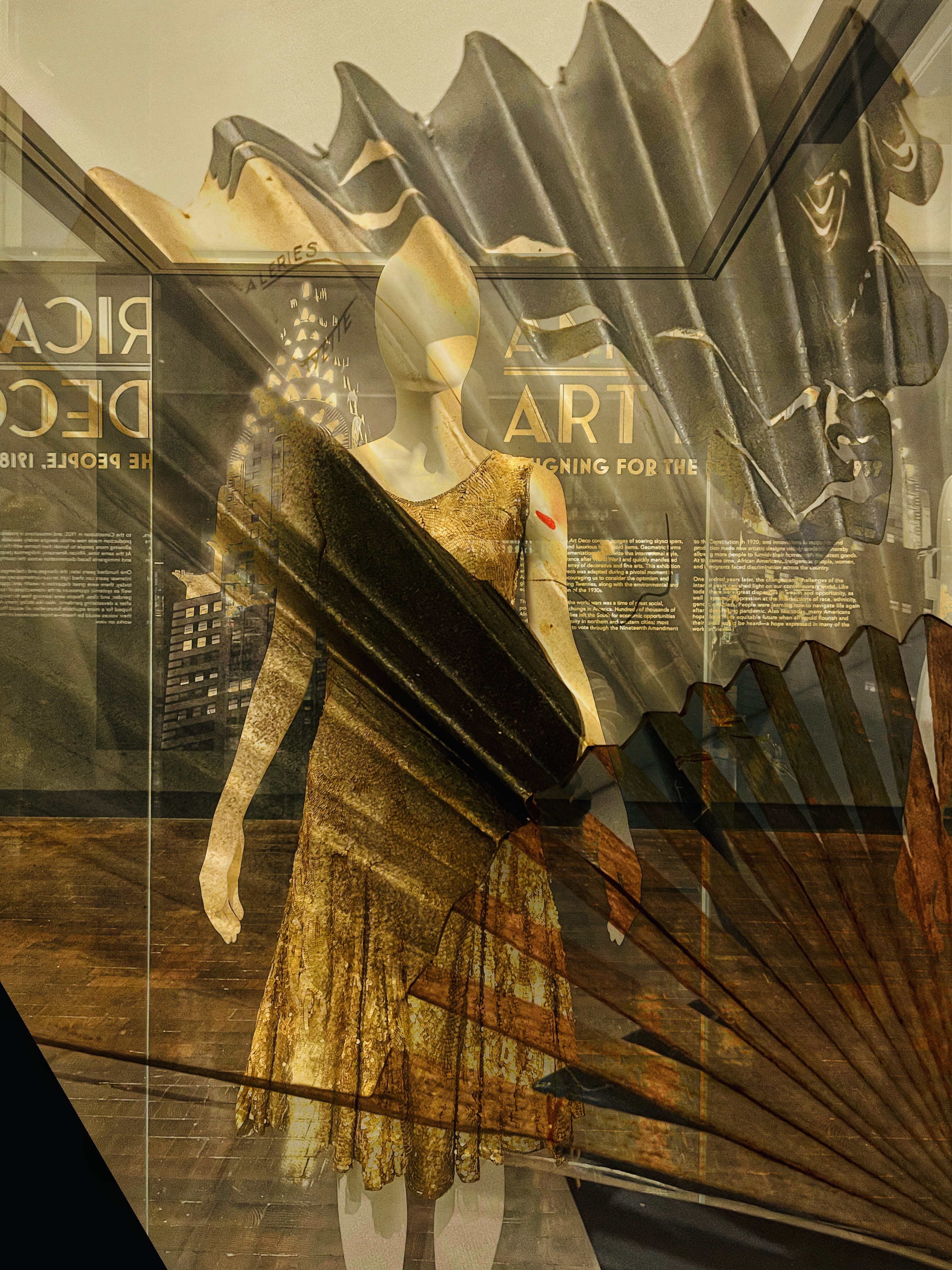
Immediately, I was shocked to notice a coincidence between the Art Deco exhibition and my new book–that I actually wrote the dates of 1919-1939, in the novel, Ripe for the Pickin’ (forthcoming 2022), as one of the primary time periods. As my friend and I entered the Art Deco exhibition space, the sequined gold flapper dress made me think about my own character’s gold pageant dress in the first book of the series, Poke Sallet Queen & the Family Medicine Wheel. Robin and her aunt discover the dress in a Nashville store where they rummage through boxes of designer clothes. In another room of the Art Deco exhibit, I swooned over the fan, as it reminded me of Miss Emy, Robin’s grandmother, who carries a fan everywhere and does not stereotypically “flutter” it, but rather uses it as a judge might wield a gavel. Naturally, I thought of putting together a picture I took of the dress with one of the fan. Unfortunately, I cannot find the titles or artists/designers of these two pieces on the online guide for the exhibition.
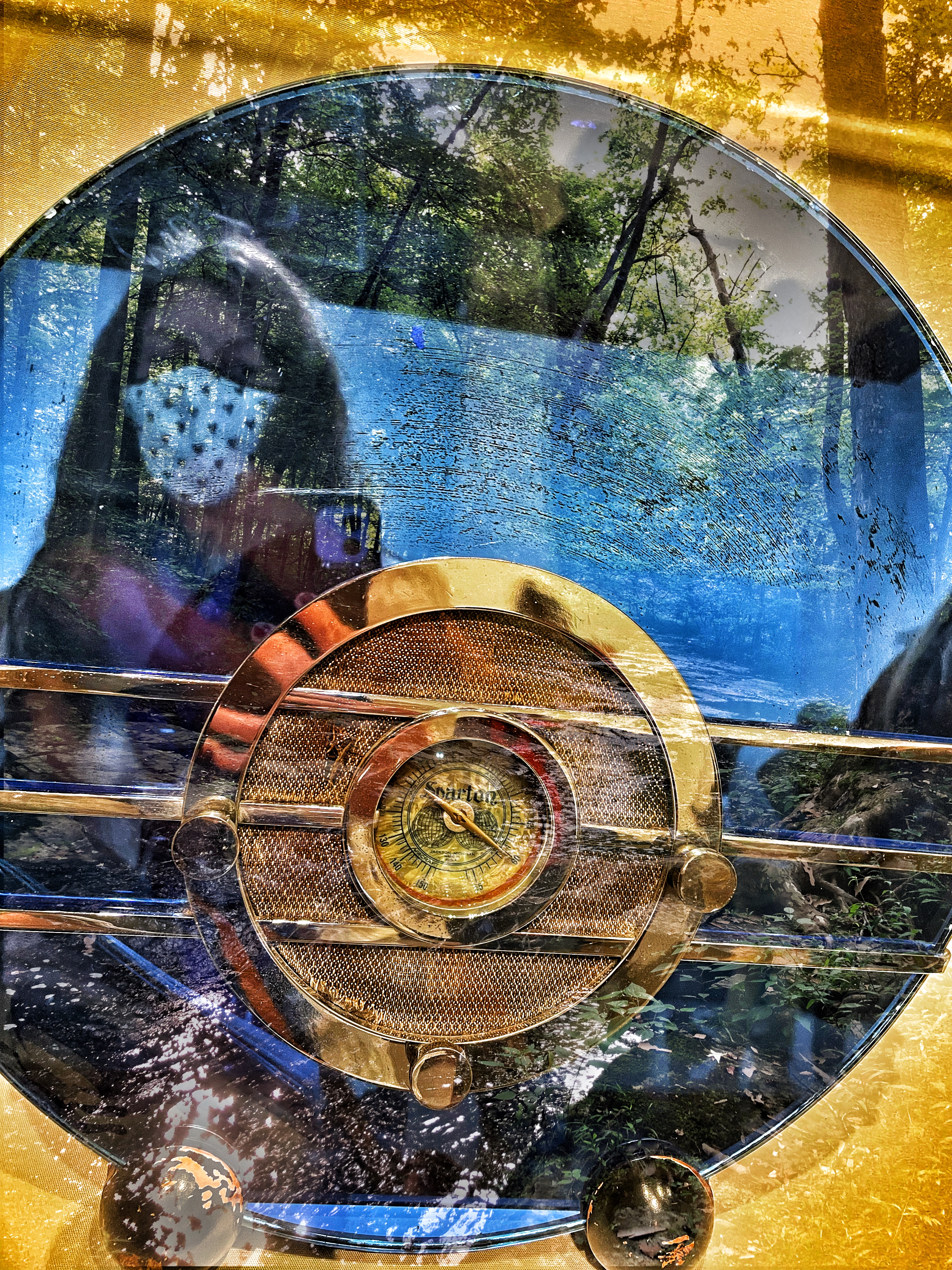
I layered my own images with pictures I took at the exhibit, too. Photo 2 is my reflection in the Spartan Bluebird Radio during the exhibit juxtaposed with a forest where I ran this summer and which was inspiration for part of the next book’s setting. Radios are a part of the story since Robin is in a folk band, and I wanted to imagine that one of the characters, maybe her relative, had one of those bluebird radios. I also like that this dates the radio and me, as I’m wearing a mask because they are required in The Frist.


The radio: Walter Dorwin Teague, designer (American, 1883–1960); Sparks-Withington Company, manufacturer (Jackson, Michigan, founded 1900). Sparton Bluebird Radio (Model 566), 1934. Wood, glass, and metal, 14 3/4 x 14 5/8 x 6 in. Collection Kirkland Museum of Fine & Decorative Art, Denver, 2004.1850.
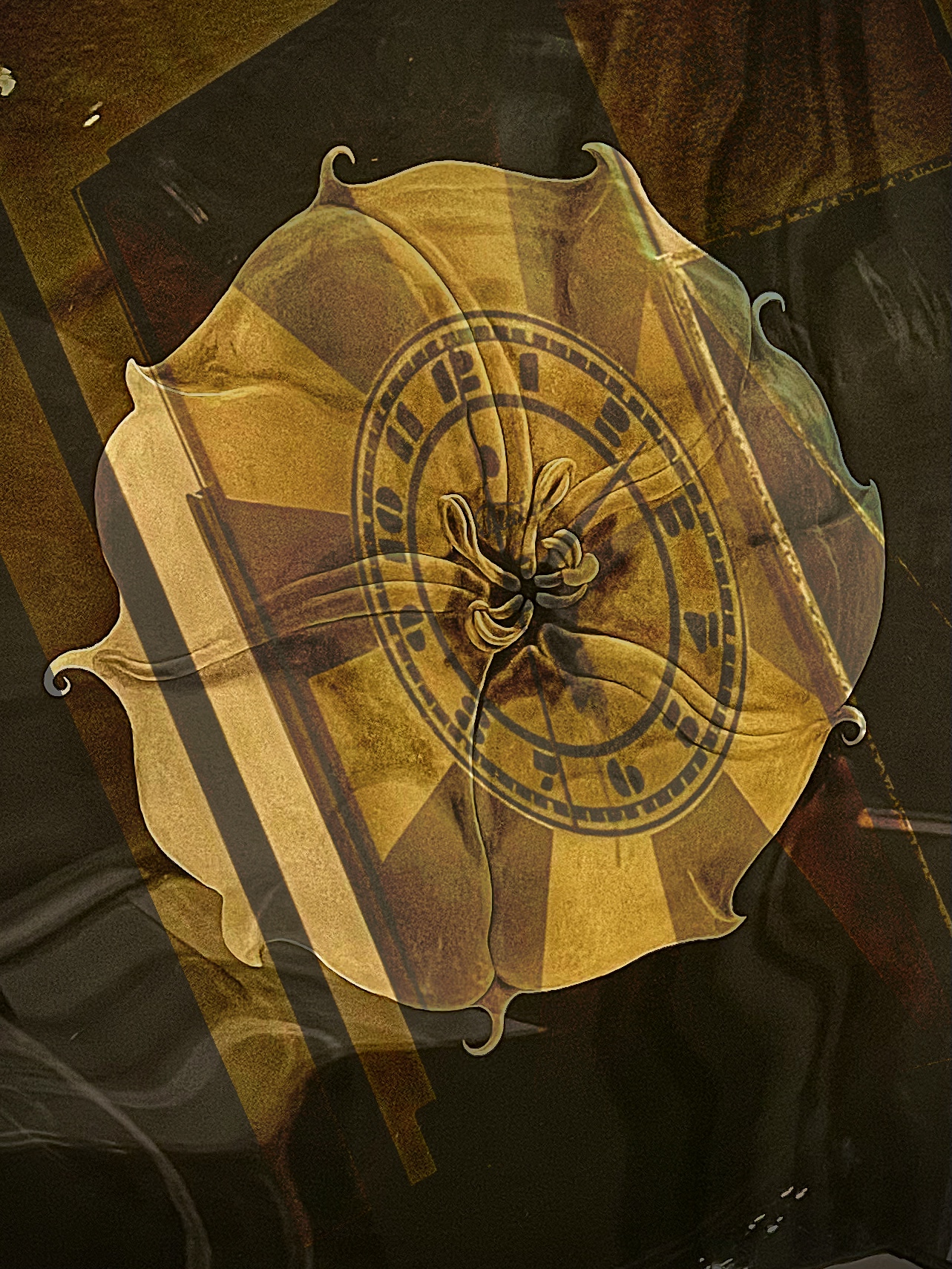

Photo 3 is a photo I took of a Steuben Glass bowl that contained Jimson Weed by Georgia O’Keeffe, and I layered it with a photo I took of Paul T Frankl’s Modernique Clock. I often write about plants and time, and the confusion of the psyche in trying to reconcile human constructs regarding schedules and nature’s own rhythms and shifts. Plants connect the characters in this book series through generations. After I put the two pictures together, the result reminded me of an Alice in Wonderland-type of image, too.

Of course, to create these images, I am using copyrighted works, but they are my images of those works, and I am not selling, duplicating, or distributing the images, so they don’t infringe upon the original works of art. I’m also citing those original artists. My layered images don’t even come close to using mastery at a level of the original artists/designers, but they do fulfill an artistic purpose for my fiction-writing. (See this website and/or a lawyer for the rules of legally appropriating and distributing copyrighted artworks).


The clock: Paul T. Frankl, designer (American, born Austria, 1887–1958); Warren Telechron Company, manufacturer (Ashland, Massachusetts, 1926–1992). Modernique Clock, 1928. Chromium-plated and enameled metal, molded Bakelite, and brush-burnished silver, 7 3/4 x 6 x 3 1/2 in. Collection Kirkland Museum of Fine & Decorative Art, Denver, Gift of Michael Merson, 2010.0670.

The bowl: Steuben Glass bowl with Jimson Weed image, 1938 Glass, 14 inches in diameter. Georgia O’Keeffe Museum. Gift of Mrs. Flora C. Crichton 1997.13.1Designer: Georgia O’Keeffe. Clear glass bowl with Jimson Weed etched in center from design


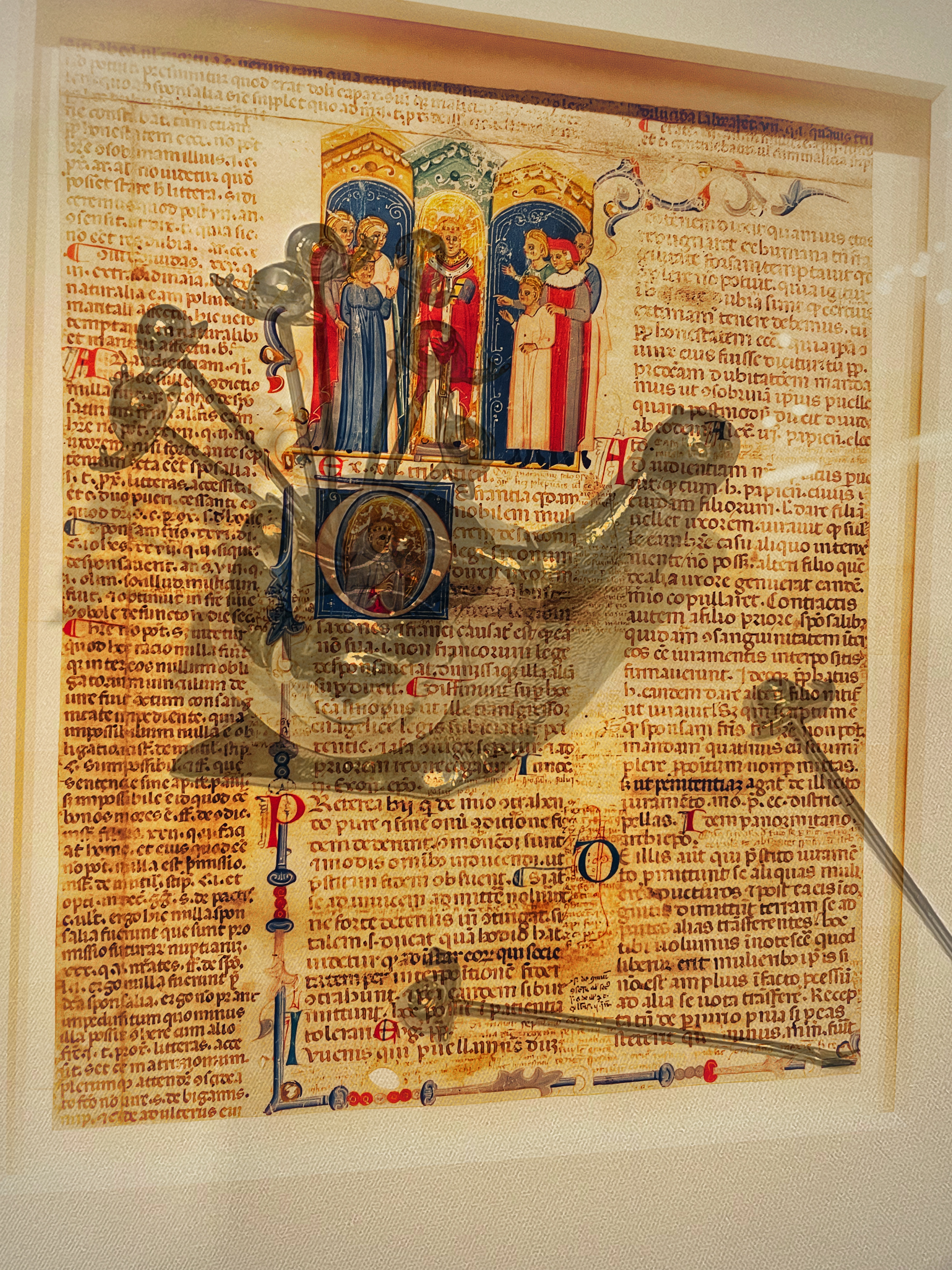
 Finally, I liked the snail cocktail picks from the Art Deco exhibit layered with an illumined manuscript from Medieval Bologna. There was no connection to my story. I simply like the idea of the slow passage of time symbolized by the snail and the old age of the manuscript.
Nothing compares to the experience of looking at the artwork, standing in front of it, taking in the scale of it, noticing the texture, focusing on the colors and form, how it shows itself in the space. However, I do enjoy this process of layering and creating even more meaning for myself.


I don’t have the details about the snail cocktail picks or the illuminated manuscript, but here are links to all the information online that The Frist Art Museum offers and online tours:

Art Deco Exhibition links

Medieval Bologna Exhibition links

The Georgia O’Keeffe Steuben Glass bowl


The Slant of a Place

Short Fiction by Shana Thornton

Author’s Note: Recently, I found a copy of my first published short story, ”The Slant of a Place.” While none of these characters has yet to appear in the Family Medicine Wheel series (Poke Sallet series), this story is set in Granville and these characters are part of the town. This Granville is a fictional place in Tennessee, though it probably bears resemblances to many small towns across the state. I wrote it in tribute to my great grandmother, but it is fiction. I want to share it here on my blog because I do see the formations of the novels I would eventually write. I also appreciate my growth as a writer, and since those back issues when it was originally published are no longer available, I want to reprint it here. (And who knows…maybe in the future one of these characters will find her way into the novels in the series.)

First published in The Smoking Poet, 2008. First reading at the Clarksville Customs House Museum and Cultural Center, 2008.

The Slant of a Place

So, the state finally took Hattie’s house back today and all the birds are gone.  

​Hattie Wheeler was born here in Granville and raised on the north side of the river known as Craggy Hope Ridge.  We call the south side of our town The Knobs.  Neither side seems different from the other one except for the trailer park located on the backside of The Knobs.  Otherwise, both sides of Granville always shared hollows, steep bluffs, winding roads, and cow pastures.  ​

​Hattie lived on a crooked road known as Shake-rag to folks on the Ridge.  The biggest curvy patch on Shake-rag is called Devil’s elbow, and that’s where Hattie’s property meets the road.  Her house sat back on a hill above the road like all the homes on Shake-rag, which cut into the land and lined up the mailboxes for Adler Flatt.  He was the postman on the Ridge for forty-two years and said that in all those days of delivering mail, Hattie always walked down her gravel driveway to meet him at the mailbox.

​“I’ve never even looked inside Hattie’s mailbox,” Adler said while a group played dominoes in front of the drugstore.  “I don’t know if it opens.”

​Bob Loftis slapped down a domino and looked up.  “That mailbox works just fine,” he told us.  “Me and Bobby Jr. leave the squirrels we shoot in there for Ms. Wheeler.  We wrap them up so they don’t mess up her mailbox.  She trades us for the preserves and soup she makes.  We take the jars she leaves in the mailbox, replace them with squirrels, and put the flag up.”

​Bob wasn’t the only one in town trading for Hattie’s food.  She had an old canning cellar and stocked it full every year.  That’s the way she survived and made a living for her and Albert, her son.  She traded and sold her jars of food to people on the Ridge.  Eventually, the news of Hattie’s canning spread to neighboring counties.  Most people didn’t spend time canning anymore; that was for the old-timers, but everybody ate Hattie’s food and wanted more.  Her canning cellar brightened when the door to the outside swung open.  Light bounced off colorful jars stacked on the dusty, plank shelves around the room.  The jars looked like antique science fiction with swollen, bulbous vegetables, some floating with fibrous tentacles, others smeared against the glass sides, some sloshing when the door banged against the shelf.  The jars were filled with slimy pickled okra, snapping turtle cucumbers with a hot pepper catch, punished beets beneath swollen tomatoes, celery tangy vegetable soup, sticky apple butter beside seedy blackberries, and the smart dull blueberry jam. 

​Junior Wheeler, Hattie’s husband, died of tuberculosis when Albert was young.  Hattie inherited what was once his family’s land.  When Junior died, the family lived in a narrow house on the hill above Devil’s Elbow.  The house was red with a tilted porch stretching across the front.  Its shiny, reflective roof was sheltered by an oak and a maple on either side.  While the Wheeler family had electricity, they didn’t have running water.  Instead, they used a well and an outhouse.  

​As a young boy, Albert roamed the town, learning to play banjos and pianos from anyone willing to teach him.  In exchange, he repaired doors, plastered walls, and painted barns.  Most folks think Albert retreated to music after Junior died.  In actuality, we know his inspiration came from the birds.      

​The most enchanting thing about Hattie’s place has been the birds.  In a field behind the house, Hattie used the old Wheeler tobacco barn to raise chickens and guineas.  The peacocks pranced across the grass among smaller wooden coops.  Wild turkeys usually crossed her land twice a day.  Hawks, cardinals, grackle, and chickadees claimed the woodlands that bordered her property.  Even further back, ducks ruled an old pond.  She learned to raise fowl from her mother, who had a talent for taming even the wild feathers.  Hattie’s mother imitated mating calls, chirps, and songs.  They say she was such a birdbrain, her daughter turned out to look like one.  Hattie was a skinny, white chicken with piercing blue-black eyes and snowy shoulder-length hair.  She kept the sides of her thin hair pulled up in little plastic barrettes.  When she smiled, her two front teeth were slightly bucked.  Her pointed nose and lips led her body forward when she walked.

​Hattie kept their place looking nice.  She whizzed the grass shorter by swinging a metal blade into the sun.  Her flowers, fluffed in yellows, pinks, and reds, bordered the small house so it wore ruffled petticoats of daffodils, hollyhocks, marigolds, and zinnias throughout the spring and summer months.  When we went to her house to buy preserves and vegetables, Hattie always met us in the yard and asked us to follow her into the house.  Even though it was little more than a shack, she insisted on inviting her customers inside to share a coke cola.  Of course, Hattie didn’t call anybody a customer.  We were guests in a house with numerous floors on what should have been one.  Albert patched holes with odd planks and boards through the decades.  Hattie didn’t act like she cared or noticed.  But to us, everything was tilted.  The small television leaned into the corner.  One foot of the couch dangled above the floorboard, while the other was grounded solidly.  We became dominoes if too many crowded onto the couch.  The floor creaked beneath our weight.  Only the corner with the radio and record player was level.  Hattie kept the radio tuned in to Acuff’s WSM radio show and the needle spinning Bill Monroe all day and well into the evening. 

​After the coke cola, we followed her out back through the screen door to the canning cellar.  There, we filled our arms and bags.  Before leaving, everyone stood with their arms full of Hattie’s jars.  She held the baby on her hip if you had one.  We gazed out over the field at the peacocks, hoping to glimpse their fans.  The mating call of those peacocks sent chills tingling up our spines and across our skulls—a big laughter escaped from a deep and unknown place, as if the birds were giving an omen.  The guineas, who Hattie said are cousins to penguins, waddled speedily around the peacocks.  Hens paced in the opening of the barn loft.  Some pecked at the dusty ground with the chicks.  It was hard to make out a nesting order.

​Hattie walked to church every Sunday morning with the intent of a guinea.  Her white hair fluffed into a feathery point from the wind.  We saw her winding the road from our car windows.  It didn’t matter if anybody offered her a ride; she only took it if there was a storm approaching.  With Albert by the hand, Hattie crossed the land of their neighbors on the way to Philadelphia.  That was the church on the Ridge.  The folks in The Knobs went to FreeWill.  

​Now, there are twenty or more churches in Granville.  Seems like when we got fast food a little over ten years ago, our town got all kinds of religion, too.  The town square is eighteen miles from the interstate on the outskirts of the county line.  That interstate has become its own town and brought all sorts of businesses, including churches, our way.  But back then, everybody went to either Philadelphia or FreeWill.

​“How-dy,” Hattie said when she walked into the church.  She gazed around the pews, smiling at everyone.  The young folks thought she was trying to copy Minnie Pearl until Brother Turner, our preacher, set them straight.

​“Hattie’s been saying that her whole life,” he said.  “When she was just a little thing, her momma brought her into town for the fair.  Her momma always won the talent shows because she could imitate any bird.  And, Hattie introduced her with that famous, ‘Howdy.’  We all think that Ms. Pearl must have visited Granville for one of our fairs.”

​Hattie sat with her three oldest friends on the back pew.  Philadelphia was a small church, only ten pews deep on both sides of the aisle.  The congregation filled a little, red brick building with white wooden trim that made a point above the doors.  The church sat on a hill that met Shake-rag and was covered in pink phlox.  ​

​Hattie sat next to the aisle.  She kept her pocket book and her dish for dinner under the pew in front of her.  At Philadelphia, we had a dinner on the ground nearly every Sunday.  After Hattie settled in and addressed her friends, she would bite off a plug of tobacco.  Hattie’s father stripped tobacco all over the Ridge, so she had a liking for that plant her whole life.  Even during the Sunday service, Hattie chewed twists of King B.  She carried two handkerchiefs.  One covered a small, metal can; after she spit the plant’s brown juice into it, she wiped her mouth with the other one.  While everybody else sang during the service, Hattie tapped a beat with her foot and chewed tobacco.  

​It seemed like out of nowhere the state had made a visit to the Wheeler property and condemned the house as unfit to live in.  They bulldozed the little tilted shack with a crackling shove and set a doublewide on top of a decent foundation.  Of course, they made an overall reform of her property and filled in the old cellar.  The only thing they left on the Wheeler land that belonged there was the tobacco barn and the birds.  Hattie would have never changed things if someone hadn’t called the state.  No one could understand why someone had complained.  It was a shame since Hattie was over eighty by then, and no one ever cared before.  

​Some suspected Albert had called the state on his own mother.  They said that he must be worried about her getting so old and using that wood stove through the winter.  Plus, he was fighting the first of his cancer at the time.  Somebody had heard Albert say his cancer was preventing him from patching the floors and toting water over to the house in the winter.  But, that seemed like a rumor and most of us knew Albert wouldn’t turn on Hattie.  Everybody on the Ridge knew he had offered to build her a new house or buy her a trailer.  She never went for those deals.  She made it plain to him and everybody else that she liked her place, running water or not, just the way Junior left it. 

​Hattie lived five years in the new doublewide with an indoor bathroom before she slipped on the kitchen linoleum a few months back and broke her hip.  Albert passed two years ago.  After the cancer spread to his liver, he couldn’t fight through another round of chemotherapy treatments.  When Hattie broke her hip, it was up to us to tell her she had to go from the hospital to the nursing home.  We knew that modular home had been too level for Hattie.  Every time she showed up at Philadelphia, she had another bruise somewhere.  But, she always laughed about it, saying she would get used to walking the straight and narrow.

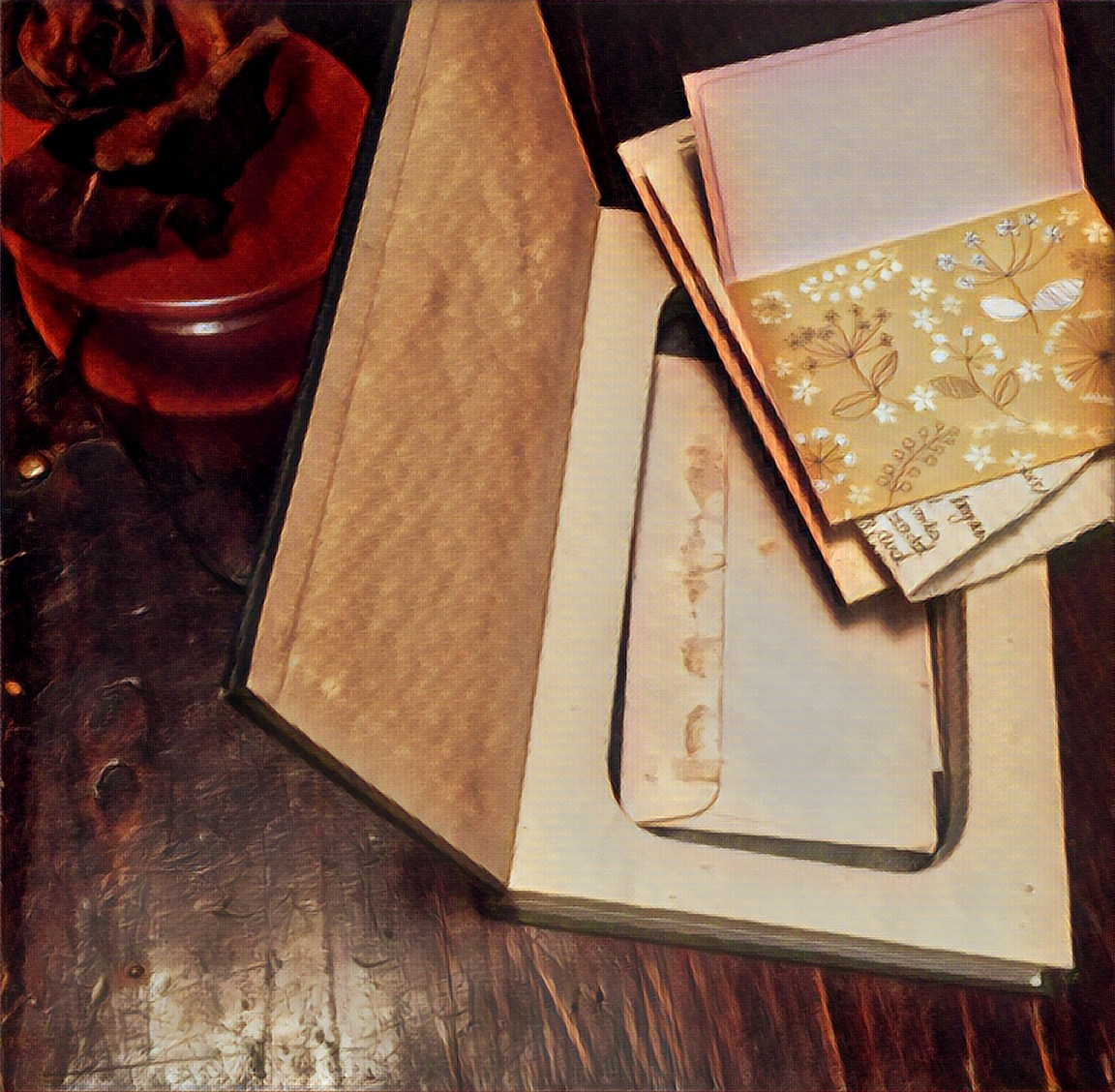
Stashed Away–The Secret Letters

This is part three of a series on letter-writing in fiction.

IMG_9684

Secret letters can create many routes in a novel, and they offer the ultimate versatility to your story. These secret letters that suddenly appear in a book, they allow some of the deepest twists possible in storytelling. The story becomes the owl with its head turned all the way around, and you might even be able to stand the plot on its head at the same time.

I’ve noticed that the novels with secret letters don’t set out to be epistolary. Those secret letters are not referenced in the beginning of the book. The narrator never alludes to letters or secrets in that way. Then, the secret letters surprise everyone by showing up like a poof of dusty magic.

You can make it subtle, while retaining the lucidity of the scene and the significance of that moment in the storyline. In Multiple Exposure, Ellen Masters is legally adopted by her grandmother and grows up with a distant relationship to her mother. When her mother comes for a rare visit to see Ellen graduate from high school, Ellen’s mother finds all of the letters with money still stuffed inside that she and Ellen’s stepfather mailed to Ellen over the years. Prior to this scene, the narrator, Ellen, has never let the reader know that her mother and stepfather mailed letters and money to her. It should come as a bit of a shocking revelation on the part of the narrator to the reader for many reasons. The scene shifts again quickly, and this serves as a striking memory flash. Those letters are never mentioned again in the book, and there’s no reason to do so, as they served their purpose in the story.

You can make secret letters have a generational impact by revealing an even bigger secret decades later. In my second novel, Poke Sallet Queen & the Family Medicine Wheel, I used the idea of secret letters again, and they lead to the revelation of a secret that changes the family structure (for this blog, I won’t spoil the story and reveal that here). These letters are about the history of the Ballard family and are never seen by the narrator, Robin Ballard. She hears the story of the secret love letters from her Great Aunt Cora, whose heart is broken as a young woman by not receiving anymore letters from her secret lover. She tells her great niece about it decades later: “I don’t think my heart stopped hoping I’d open the mailbox and find my name written by his hand until I finally married someone else and moved away from there. It was like the mailbox could never be the same again.” For Cora, the letters are painful, but for her great niece, Robin, they are a revelation.

To read more about Multiple Exposure, my
first novel about narrator Ellen Masters who is trying to raise her daughter, hold down a career and home, all while facing the fears that surface due to her husband’s deployments to Afghanistan and Iraq and a shocking murder that takes place close to her home, visit thorncraftpublishing.com

You’ll also find more information about my second novel, Poke Sallet Queen and the Family Medicine Wheel, which follows the generational stories of a middle Tennessee family and the various talents of the Ballard family, from shaman, to moonshiner, to singer, and more.

Parts One and two in this series are about the confessional letter and passing notes in high school, respectively.

Flashback: Passing Notes in High School

This is part two of a series on letter-writing in literature.

IMG_9595

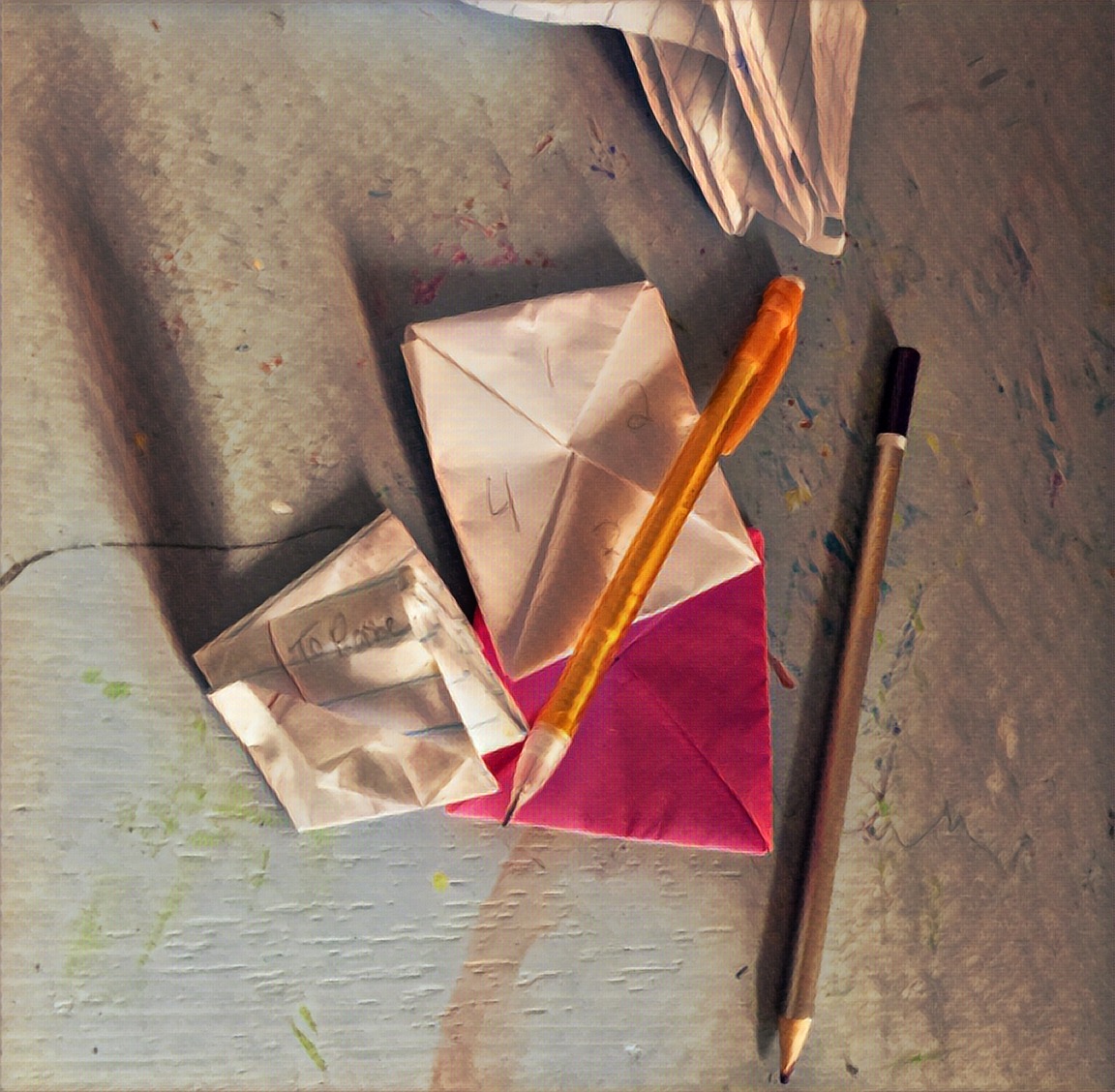
The days of passing paper notes in school are fading from our culture. When I was in high school over twenty years ago, we used notebook paper and created elaborate folds, code words, and nicknames. We knew where to pass notes between classes, when to pass them during class, and even who could be trusted to pass a note without reading it. Now, most students simply send texts and emails to one another with their phones.

In her novel, The Mosquito Hours, Melissa Corliss DeLorenzo reminds the reader about these changes in communications and letter writing. The epistolary novel doesn’t have to be a book about letters mailed and received through the post office. DeLorenzo shows how friends write notes in school, and she shares the correspondence between best friends Vivian and Raine in high school. DeLorenzo allows the reader to see Vivian and Raine’s code words. This reveals the slang and cultural trends, but it also makes the reader feel intimately involved in the relationship between the friends. Showing the letters expresses their relationship in a way that we wouldn’t have understood without the notes. We can see Vivian as a high school girl, even though she is a young grandmother during the current time of the story. The notes act as flashbacks to reveal a different time in her life. Thus, the notes show us their relationship rather than a character telling the reader about their past.

To read more about The Mosquito Hours by Melissa Corliss DeLorenzo, a novel suggested as a Best Summer Reads of 2014 on OnPoint Radio, visit www.thorncraftpublishing.com

Next week, I’ll continue writing about letter-writing in literature. See last week’s post on the Confessional Letter for part one.