Foraging for Plants, Music, & Family

We toted the guitar out in the summer heat, after our beach vacation, while we picked blackberries. Silvia’s dress snagged on the thorns. I was writing about a heartache that constantly pulses reminders because of the realization that there’s no way to make up for a past that’s never coming back. I felt the pull of my characters, especially Robin, her confusion over both memory loss and memory resurfacIng, her dreams to rise above her family’s addictions, and the fire in her heart and her pen to write folk songs.
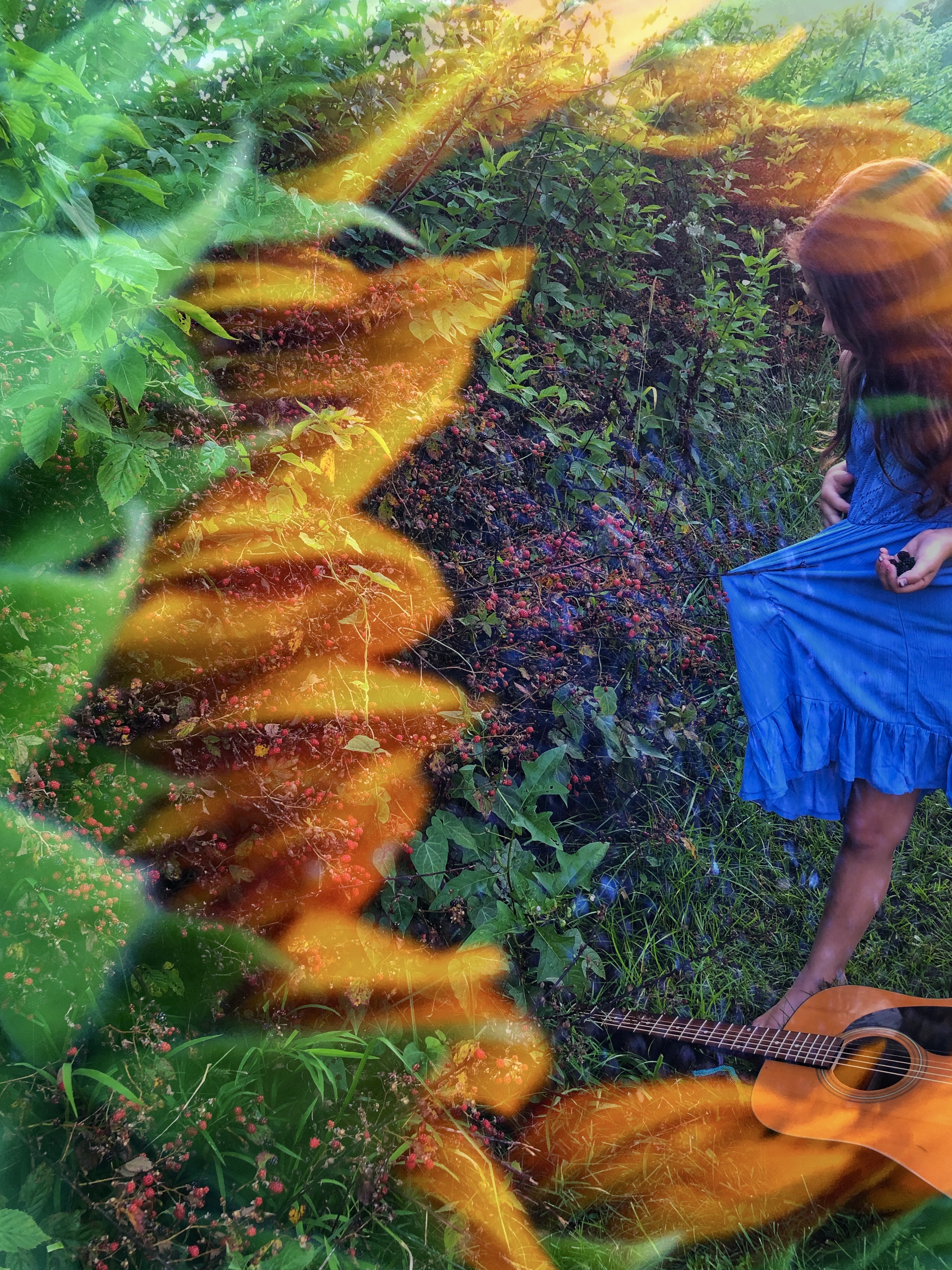
Image Title: Snagged Pickin’. Photos by Zoe Morris and Shana Thornton. Final image by Shana Thornton.

Foraging for plants and folklore, folk music, and family secrets are themes in the Family Medicine Wheel series, and they especially show up in my next book, Ripe for the Pickin’ (Forthcoming March 2022). In the first book, Poke Sallet Queen and the Family Medicine Wheel (2015), young Robin learns to forage for plants from her dad and other relatives. She also meets the friends who become her bandmates. In the next book, Ripe for the Pickin’, Robin shares more about foraging when she was growing up, and she begins her songwriting partnerships. Robin also makes a remarkable discovery in this book and that allows her to learn about her ancestors.

For the past seven years, I’ve been actively researching plants for the book, Ripe for the Pickin’. The research is a big part of my life, and my family usually participates. While we were out picking plants one afternoon, I asked our younger daughter, Silvia, if we could take photos for the book. I wanted them for inspiration. I also asked our older daughter, Zoe, if she would take some of the photos, too. These images are some of the photos we took, and they have been layered, and some even look quilted together.
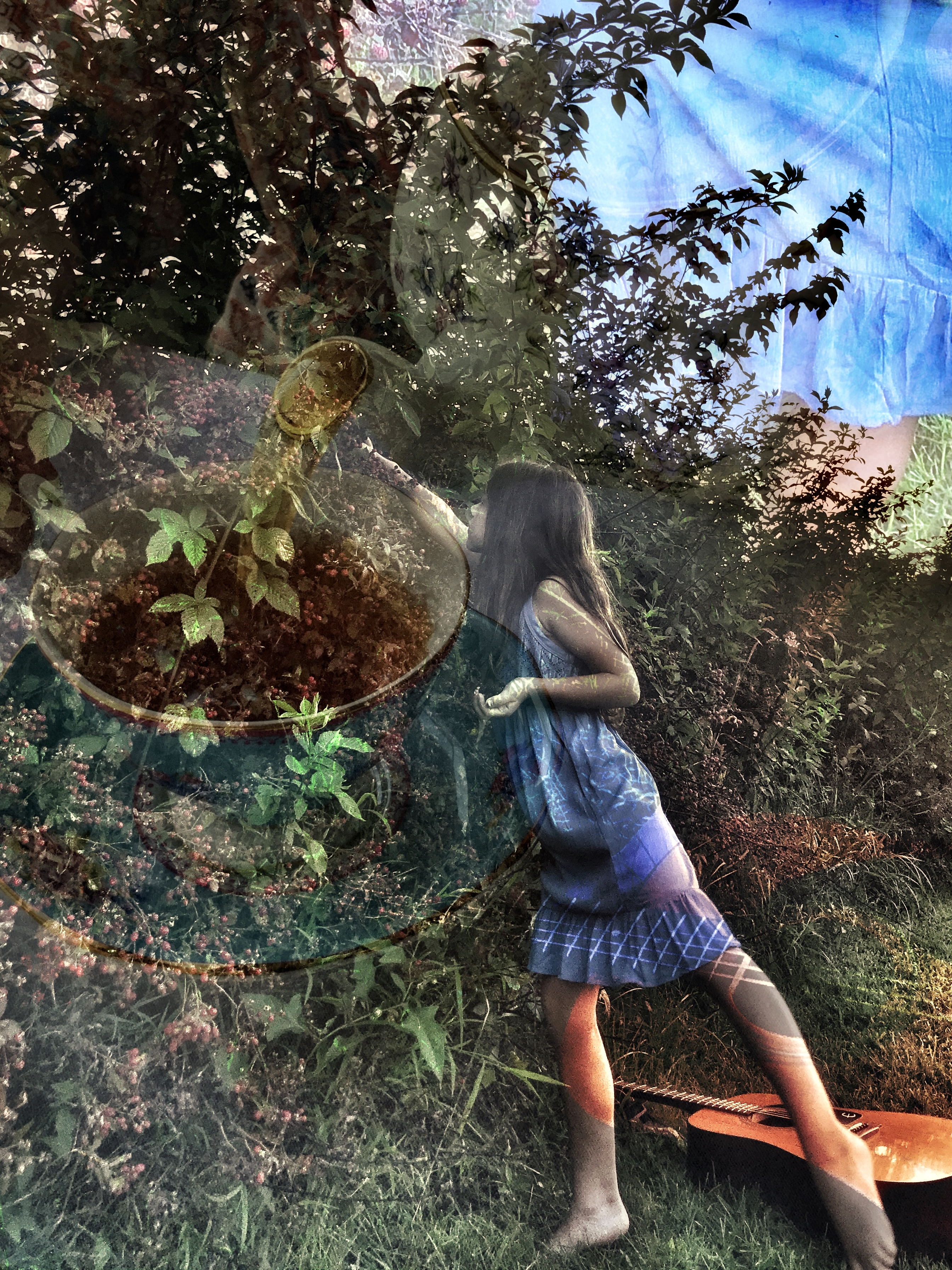
Title: Pickin’ Tea. Photos by Zoe Morris. Final image by Shana Thornton

Eerily similar to the best ideas in the book is the life that I live:

“Is this the peppery chickweed?” Silvia asks me. A fluffy type grows by the river and has a stronger flavor than the more straggly plants nearer to our house.

She and I pick wild violets for tea every spring. This became the inspiration for a chapter of the book called “Backyard Spring,” and then it inspired a song. I crafted one like Robin might for her band, and I added it to the book. Writing songs was fun, and so different from narrative that I wanted to do it again. I tried. Ohhhhhhhh, I like Robin Ballard and her songwriting journals. I helped her to fill them up.

Silvia eats wood sorrel year round where it stays warm and green close to the house. This became the inspiration for a chapter called “Cowbird Blues” and another song.

We pick the creeping charlie leaves that grow under blackberry canes, and then we pick blackberry leaves for tea, too. And, you might have guessed already…another chapter called “Blackberry Winter Whistlin’ Tune” and another song…

This got us on a songwriting streak. And, I’m in love with it…


I was daydreaming one afternoon while placing images together. I don’t know what compelled me to choose the images or arrange them, but I liked the final result when I stopped my creative daydreaming. This final image contains four photographs with three of them placed on an image of the interior of the Frist Art Museum.
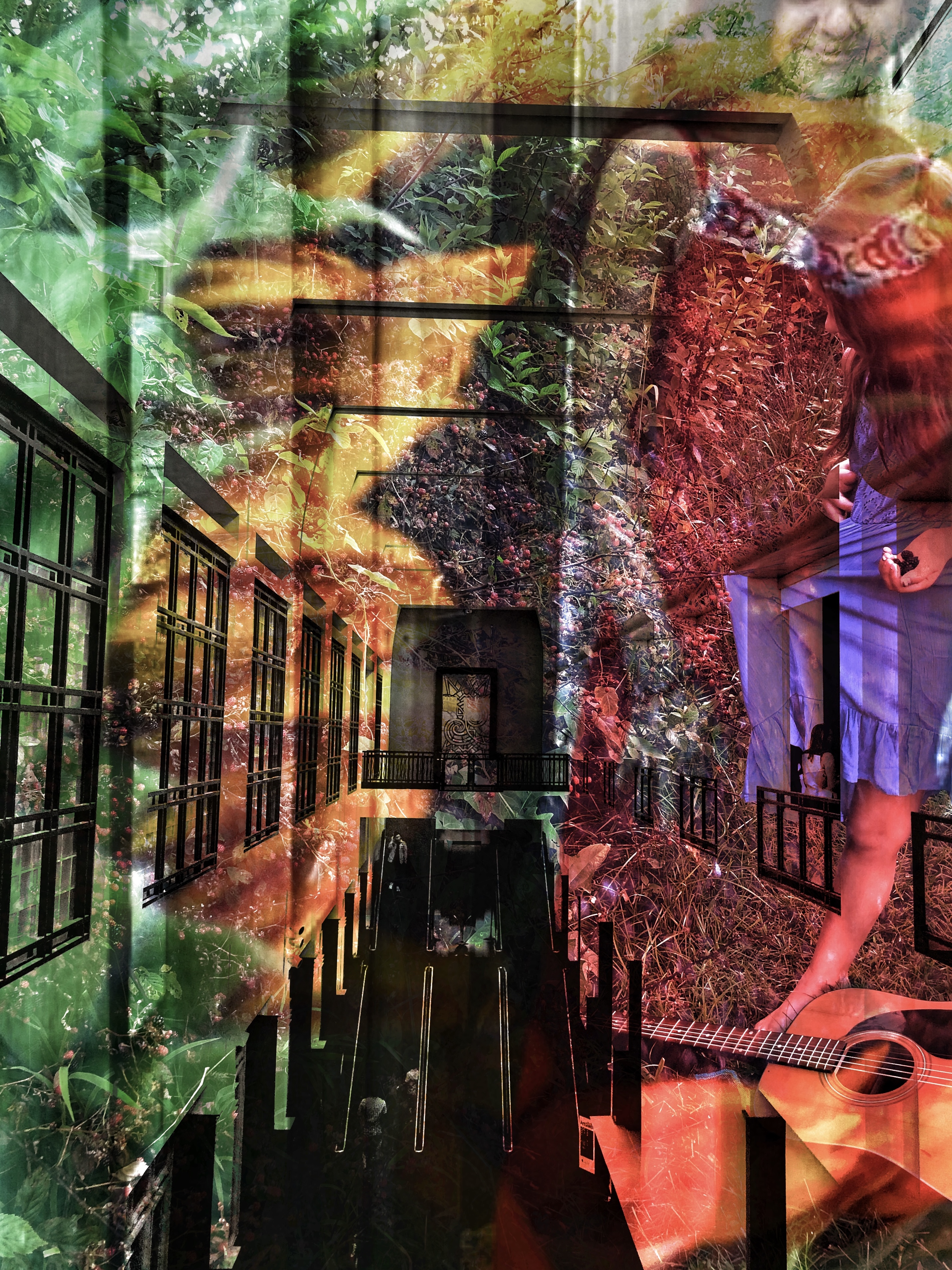
Image Title: Plant Music Pickin’ Compilation. Photos by Shana Thornton, Zoe Morris, and Terry Morris.
Final image by Shana Thornton

I enjoy the creativity that the books inspire in my family’s everyday life. We have a cabinet full of tea, a drying rack overflowing with leaves and flowers, and an experimental garden of wild plants, heirlooms, and seeds given to me by family and friends. We water the plants. We drink the tea. We sing.

Right now, as I finish this blog, someone is playing the piano and trying to write a song in the living room, probably Terry. I can hear Silvia singing from upstairs, her voice drifting off while she makes up words and when she finds them, it rises again. From the kitchen, I can hear the water boiling in the kettle for someone’s tea, probably Zoe’s.
Read more about the books here.

Art of Layering

Art is meditative and transformative for me. Even if I stare for a long time, the experience is active within me. Moving through a museum or a gallery, gazing at a painting, waiting to view artwork, standing at a distance to see more clearly, and viewing a sculpture with someone else–all of that is more of an experience than the passive idea of watching or looking at something casually. I try to imagine painters on scaffolding when I see an immense canvas stretching up toward the ceiling. I stoop and squint at the tiny forms in a contemporary sculpture exhibit. There is not a way to duplicate the feeling of scale on a computer-generated tour of a museum, and yet, I encourage online tours and know they benefit so many people.

I enjoy not only going to see artwork in exhibitions, but the art that I view often becomes part of my own creative process. In the exhibitions that permit me to do so, I take photographs of the artwork on display as well as the space where the exhibition takes place. Later, back at home, in the middle of the night, or when I am parked in a line of cars waiting to pick up one of my daughters, I layer the images. The act of layering images pushes my brain into a new creative space and actually helps me to write imagery in my books. I don’t often share my visual processes, other than a photo of places where I run and that sort of thing on Instagram (IG). I did enjoy layering nature and yoga images for a series on IG, but otherwise, I don’t usually share these images and how they inspire me. I’d like to change that and share some of them on my blog sometimes.

This series of images, the most recent I’ve created, uses photos I took from the recent exhibitions at The Frist Art Museum in Nashville: “American Art Deco: Designing for the People 1918-1939” (ended January 2, 2021) and “Medieval Bologna: Art for a University City” (exhibit up until Jan 31).

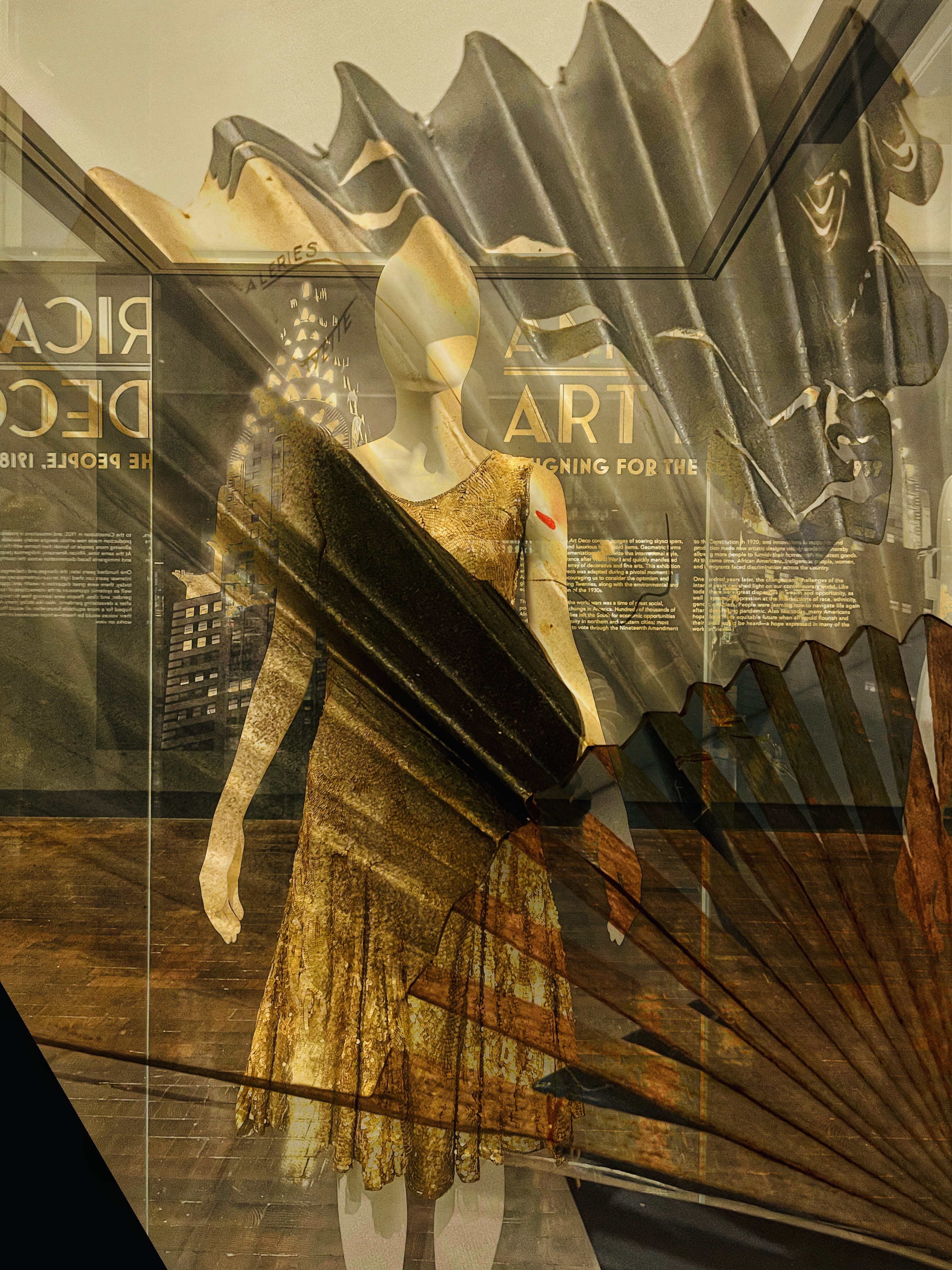
Immediately, I was shocked to notice a coincidence between the Art Deco exhibition and my new book–that I actually wrote the dates of 1919-1939, in the novel, Ripe for the Pickin’ (forthcoming 2022), as one of the primary time periods. As my friend and I entered the Art Deco exhibition space, the sequined gold flapper dress made me think about my own character’s gold pageant dress in the first book of the series, Poke Sallet Queen & the Family Medicine Wheel. Robin and her aunt discover the dress in a Nashville store where they rummage through boxes of designer clothes. In another room of the Art Deco exhibit, I swooned over the fan, as it reminded me of Miss Emy, Robin’s grandmother, who carries a fan everywhere and does not stereotypically “flutter” it, but rather uses it as a judge might wield a gavel. Naturally, I thought of putting together a picture I took of the dress with one of the fan. Unfortunately, I cannot find the titles or artists/designers of these two pieces on the online guide for the exhibition.

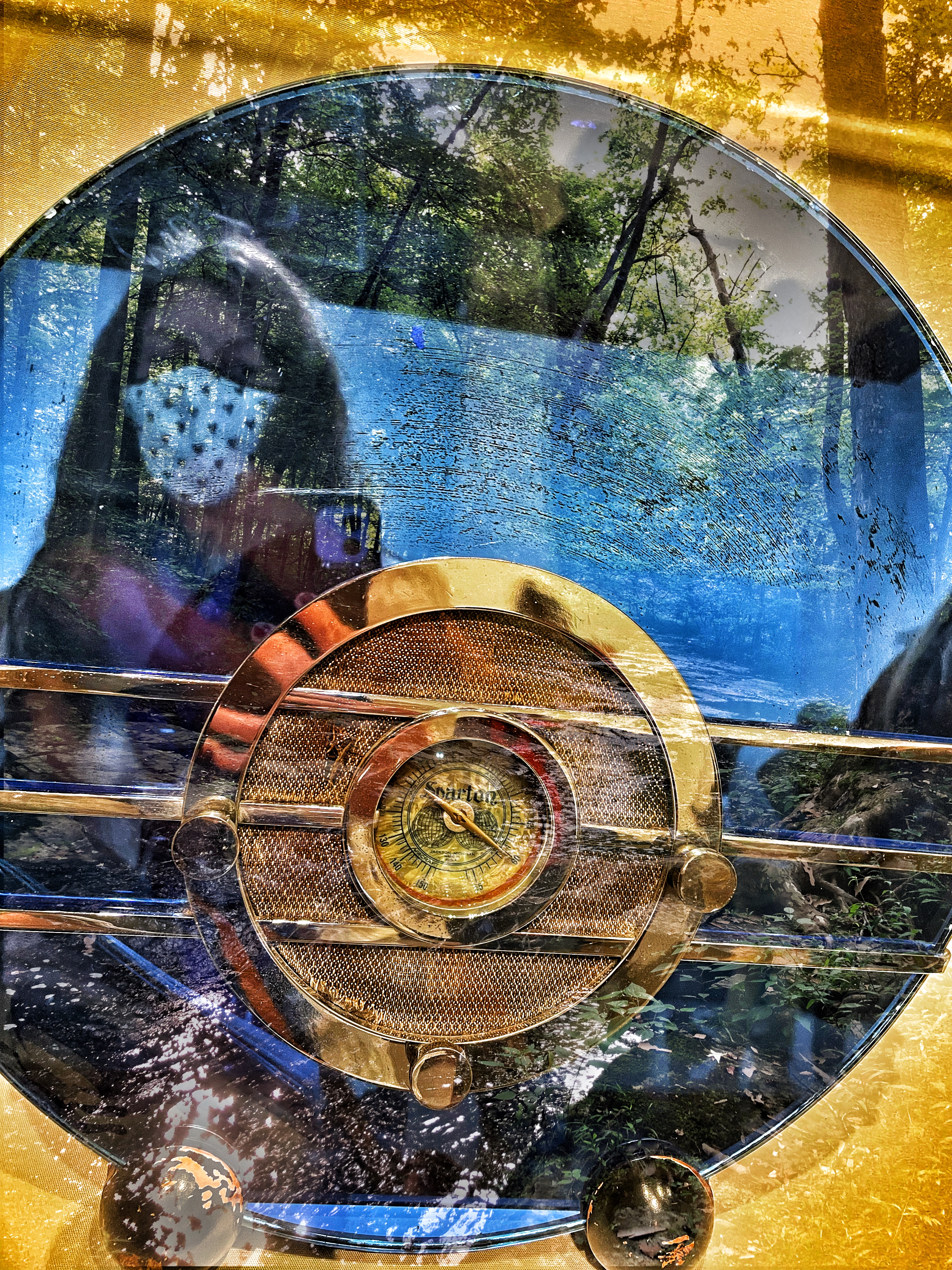
I layered my own images with pictures I took at the exhibit, too. Photo 2 is my reflection in the Spartan Bluebird Radio during the exhibit juxtaposed with a forest where I ran this summer and which was inspiration for part of the next book’s setting. Radios are a part of the story since Robin is in a folk band, and I wanted to imagine that one of the characters, maybe her relative, had one of those bluebird radios. I also like that this dates the radio and me, as I’m wearing a mask because they are required in The Frist.


The radio: Walter Dorwin Teague, designer (American, 1883–1960); Sparks-Withington Company, manufacturer (Jackson, Michigan, founded 1900). Sparton Bluebird Radio (Model 566), 1934. Wood, glass, and metal, 14 3/4 x 14 5/8 x 6 in. Collection Kirkland Museum of Fine & Decorative Art, Denver, 2004.1850.


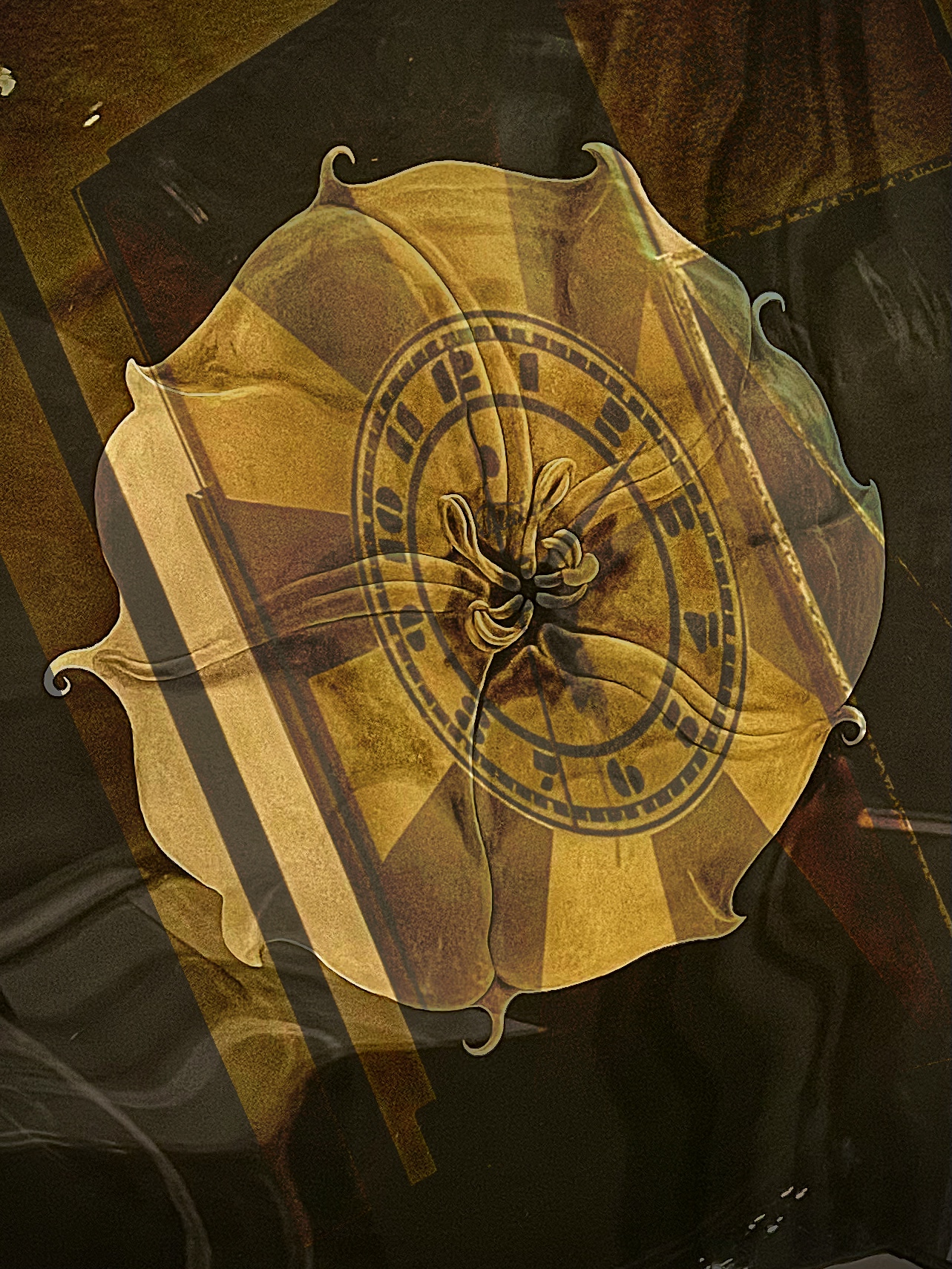
Photo 3 is a photo I took of a Steuben Glass bowl that contained Jimson Weed by Georgia O’Keeffe, and I layered it with a photo I took of Paul T Frankl’s Modernique Clock. I often write about plants and time, and the confusion of the psyche in trying to reconcile human constructs regarding schedules and nature’s own rhythms and shifts. Plants connect the characters in this book series through generations. After I put the two pictures together, the result reminded me of an Alice in Wonderland-type of image, too.

Of course, to create these images, I am using copyrighted works, but they are my images of those works, and I am not selling, duplicating, or distributing the images, so they don’t infringe upon the original works of art. I’m also citing those original artists. My layered images don’t even come close to using mastery at a level of the original artists/designers, but they do fulfill an artistic purpose for my fiction-writing. (See this website and/or a lawyer for the rules of legally appropriating and distributing copyrighted artworks).


The clock: Paul T. Frankl, designer (American, born Austria, 1887–1958); Warren Telechron Company, manufacturer (Ashland, Massachusetts, 1926–1992). Modernique Clock, 1928. Chromium-plated and enameled metal, molded Bakelite, and brush-burnished silver, 7 3/4 x 6 x 3 1/2 in. Collection Kirkland Museum of Fine & Decorative Art, Denver, Gift of Michael Merson, 2010.0670.

The bowl: Steuben Glass bowl with Jimson Weed image, 1938 Glass, 14 inches in diameter. Georgia O’Keeffe Museum. Gift of Mrs. Flora C. Crichton 1997.13.1Designer: Georgia O’Keeffe. Clear glass bowl with Jimson Weed etched in center from design


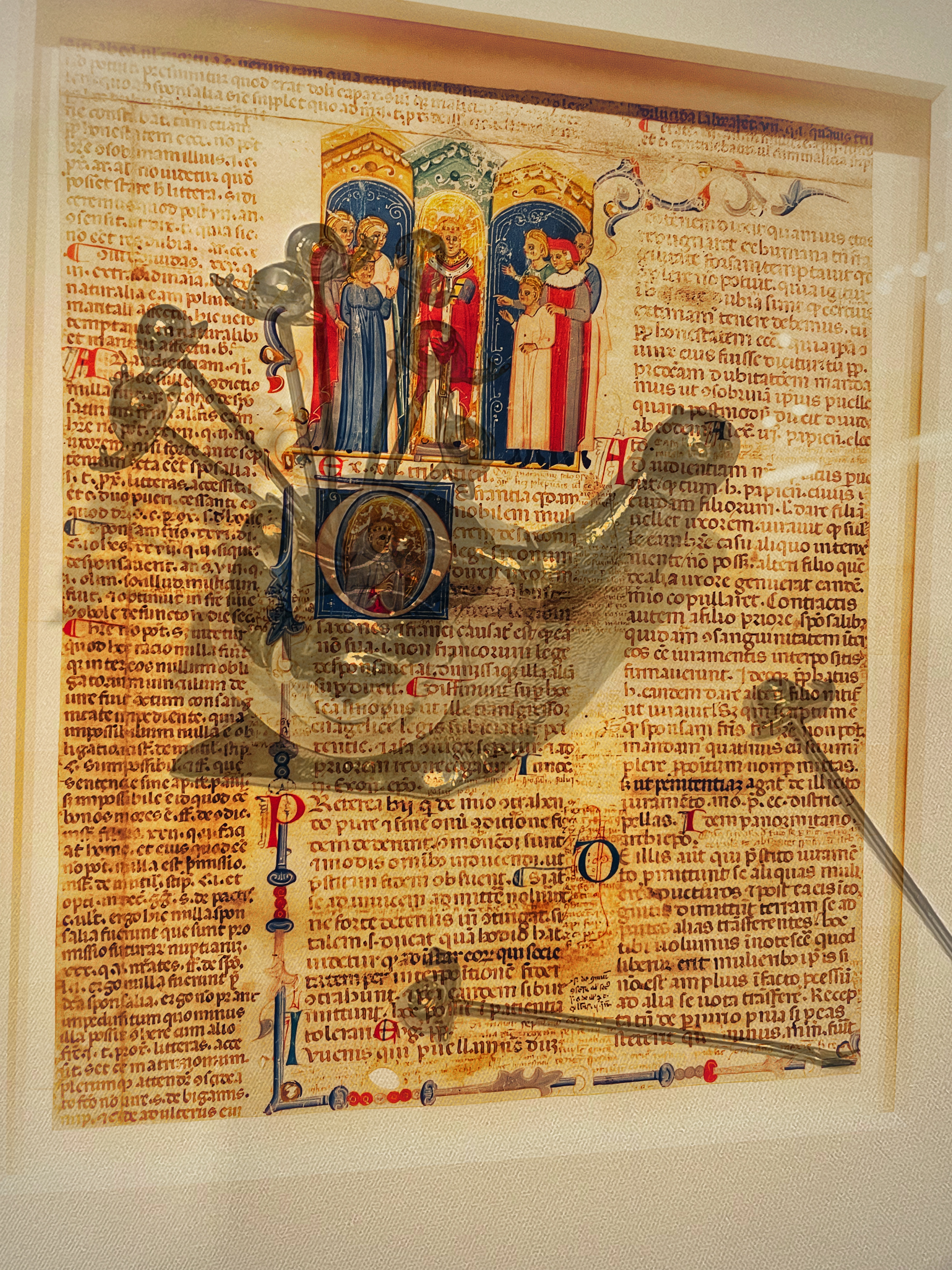
 Finally, I liked the snail cocktail picks from the Art Deco exhibit layered with an illumined manuscript from Medieval Bologna. There was no connection to my story. I simply like the idea of the slow passage of time symbolized by the snail and the old age of the manuscript.

Nothing compares to the experience of looking at the artwork, standing in front of it, taking in the scale of it, noticing the texture, focusing on the colors and form, how it shows itself in the space. However, I do enjoy this process of layering and creating even more meaning for myself.


I don’t have the details about the snail cocktail picks or the illuminated manuscript, but here are links to all the information online that The Frist Art Museum offers and online tours:

Art Deco Exhibition links

Medieval Bologna Exhibition links

The Georgia O’Keeffe Steuben Glass bowl


Savoring the Words: Unplugging Part 3

While I was unplugged, I read Tennyson’s Idylls of the King, mostly aloud to my dog, Mojo. He enjoyed the readings and would get very cozy and doze off to sleep after about twenty minutes of reading. I have an edition from the early 1900s and the pages flake sometimes, but I toted the little hardback around the house and allowed it to rest in my jacket pocket, where it fit so neatly and carried the appropriate heft for such a literary work. I could feel it there, the strength of those ideas and words. I love the way that Tennyson lingers on a description, crafting it out the long way. I found myself longing for the space, the way of wading into words and stories of old without the rush of time, the interruptions of technological life, and the self-consciousness of minimalism dragging the story down and making it less than it is…less reading enjoyment, less wandering in the world of a tale, less words.

I’ve also dwelt more on the words I write–in correspondence to others, in blog posts, and in my novel writing. I’ve allowed myself the words I want to use without making it less for the sake of other people.

The idea that I should shorten my statements and lessen my self-expressions is something I began when I first got a phone that would send text messages, and I was a late adopter so that was about 2011. Prior to that, I was quite old-fashioned (and still am) in my style of lengthy correspondence (and I prefer handwritten letters). After getting a smart phone, I very quickly learned that the majority of people I knew expected a text that involved as few words as possible. In fact, I wasn’t treated very well when I sent a text message that contained sentences. Some of my friends were downright rude, and justified their rude behavior based on popular culture. It was more okay to be rude via minimal text message than to communicate in complete sentences, even if they were short sentences. Being rude was cool; thoughtful communication was not cool. Finally, I experience changes to the above scenario, and many of my friends now communicate more akin to my own style of communication (and, I’m grateful for that).

All of this has reaffirmed my commitment to print books and handwritten letters. I’ve returned to my in-progress novels with renewed determination to finish them and to give them the full breadth that they deserve as stories, to use my breath as words penned down to the page, a motion of creation that has moved through my body and been born onto the page. As I breathe and read the words, write the words, speak the stories, they have lived inside of me. Yes, our stories do live any way, but there is no surer way of saving them for someone almost one hundred years later, and another hundred years later, and another hundred years later, than to tell the whole story out onto the page while loving the words and the process of creating with them.

Unplugging more has also reaffirmed my love of the spoken word and reading aloud. When I read stories and listen to the sound of the story, a new depth is present. There’s so much to discover in listening.

I Marvel at Mockingbirds

The book proof for Thorncraft’s 7th title arrived in the mail during a late summer rainstorm while the sun was shining. As I opened the book, I suddenly heard bird songs and chatter, and I looked up expecting to see starlings or a similar flock.

image

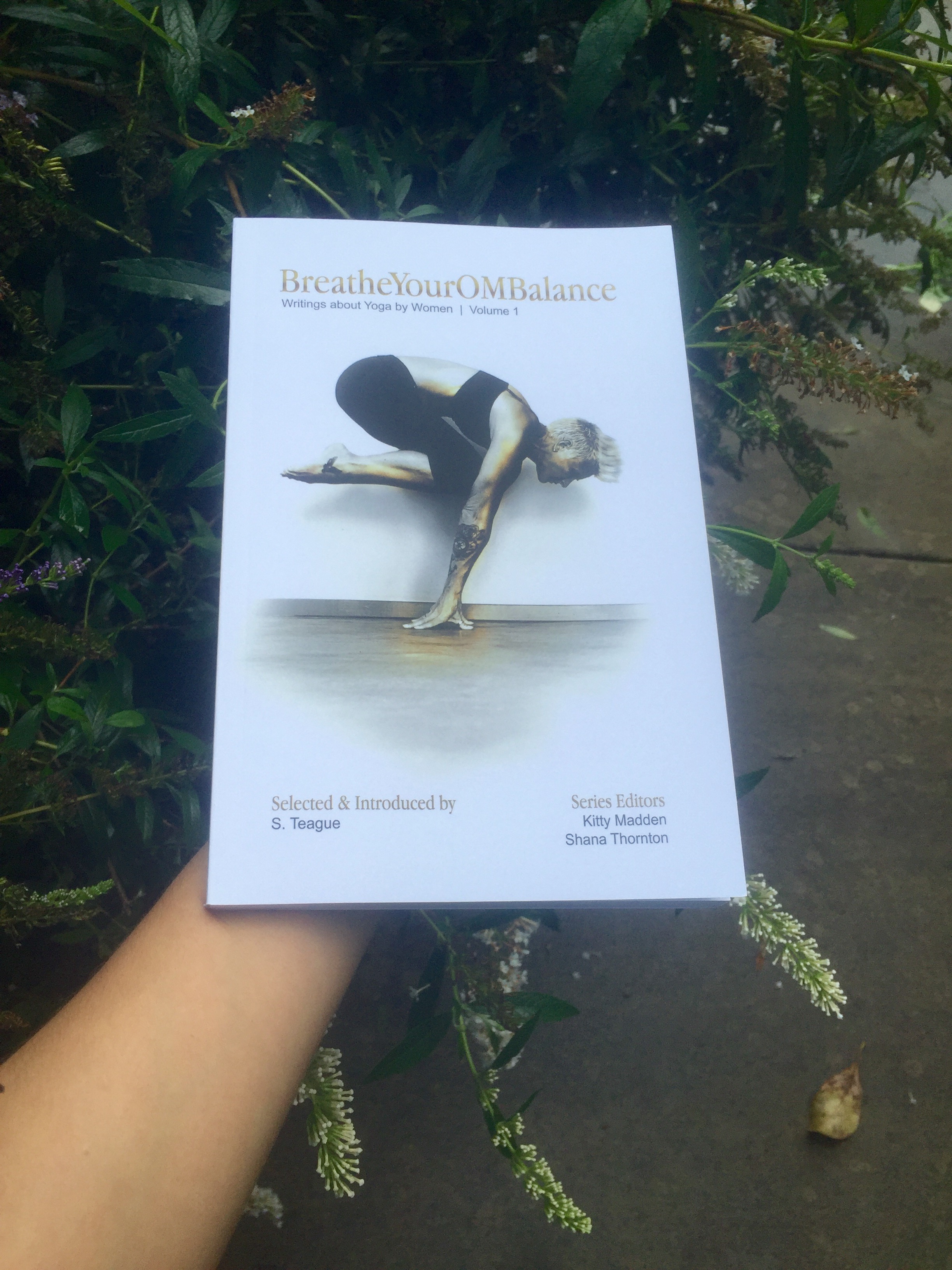
Cover designed by etcetera… Cover image by SaltH2Ophotography


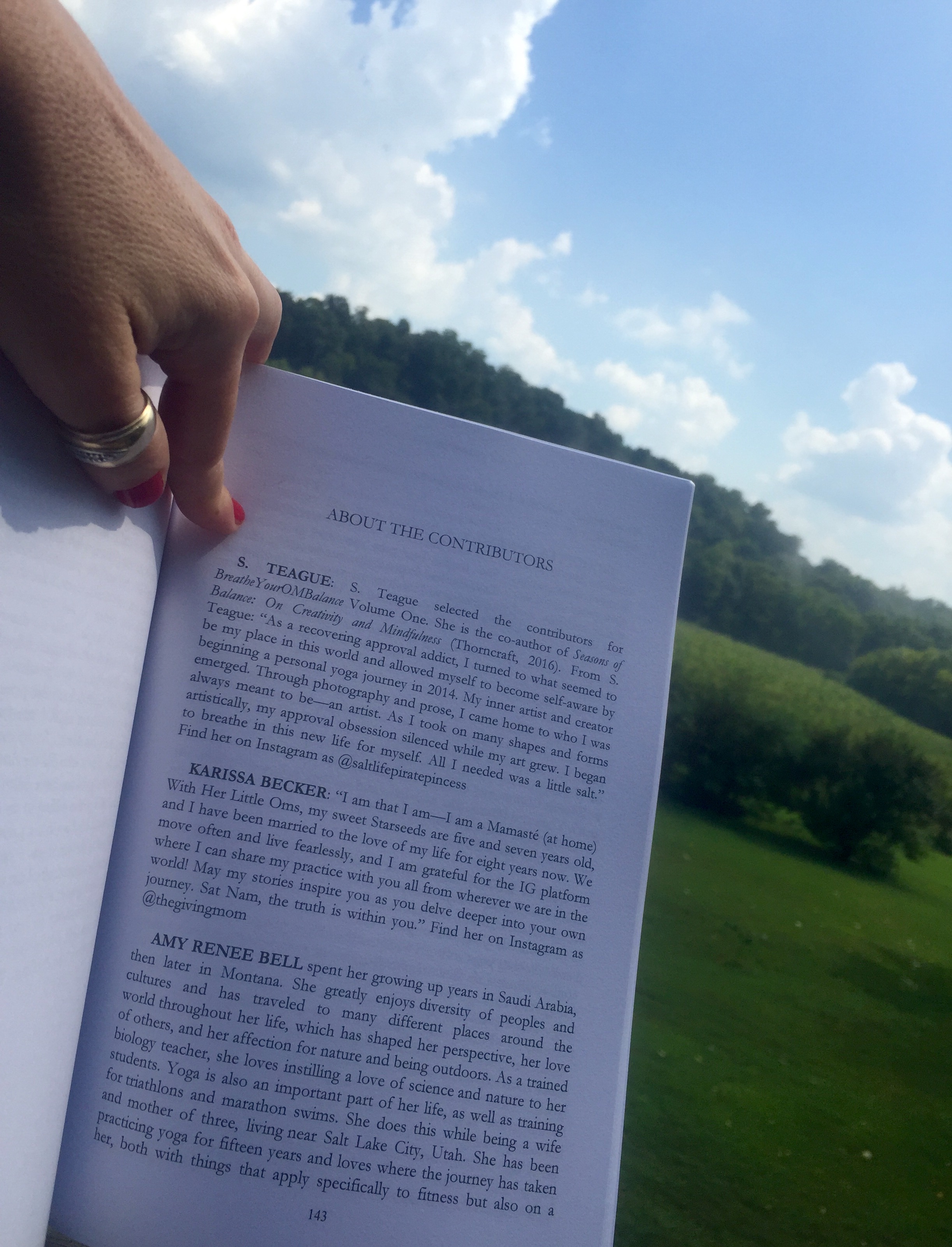
I realize that they are mockingbirds. I’ve never seen this many mockingbirds in one yard. I count over 20 of them playing around the dying garden, in the field, flapping from cedar tree to fence to persimmon branches to vitex bushes. Around 30, I give up the count and watch as the birds swoop and the white of their wings flashes against the green of the field. They whistle, chip, tweet, chirpity chirpity chirpity, st-weeet with a little trilling laugh on the end of the call. The calls and songs are so varied that I grasp for ways to describe them. It’s better to listen and enjoy. I marvel at the similarity in this first volume of the BreatheYourOMBalance book, thoughtfully selected and introduced by S. Teague.

As I read through the stories and poems, I am taken aback by the number of voices moving through Thorncraft. I’m always grateful for each book. Each one has represented a different stage in the publishing process for me, new awareness, and growth into another form. Every book has been unique to the author and my relationship with that person, as I care for all of the books that we make throughout the process.

image

image

The Breathe book includes work from 28 women who have enriched my experience as a publisher by sharing their voices, and some of them by opening themselves to working through the editing process. I’m humbled that they trusted me to share their ideas, and I’m proud of their courage and dedication, both of which shine in these stories about the transformative practice of yoga.

This is Thorncraft’s 7th book. Five books of fiction. One book of collaborative nonfiction. One series book about yoga by women. 4 book authors. 28 contributing authors. I marvel that this creative endeavor continues to grow and include women who make me proud to share their work.

image

Now, the book proof goes into the trusted hands and under the “red pen” (she actually uses blue or black most of the time) of senior editor, Kitty Madden. In the meantime, we’re excited to share some blurbs about the book from authors as well as fitness and yoga instructors. Book Forthcoming, Fall 2016. Visit http://www.thorncraftpublishing.com for more details about all of our books and authors